
Why CRM-Built Audiences Keep Outperforming CDP Segments — a Year of Data
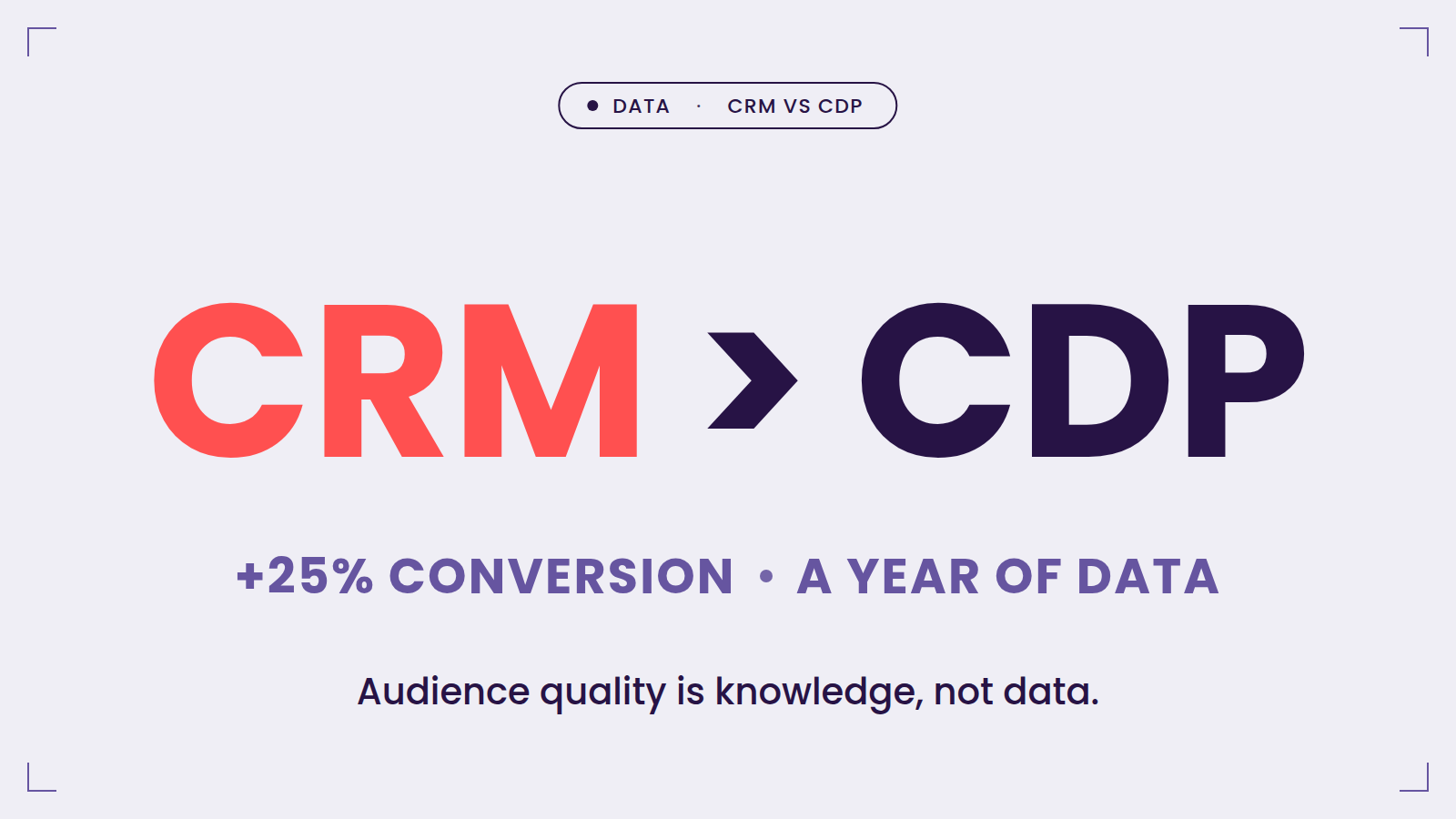
When we first published the number — CRM-built audiences converting on average +25% better than CDP-built segments on equivalent paid campaigns, across the Cezium customer base — the pushback was immediate and reasonable: that can't be structural. CDPs have richer behavioral data, unified profiles, identity resolution. Surely the CRM advantage is a transition artifact that disappears as CDP deployments mature.
A year and an Advertising Studio retirement later, we have watched more organizations run both models side by side than ever before — some mid-migration, some running dual activation layers on purpose. The gap has not closed. And we now think we understand it well enough to say why it is structural, and what it predicts about the post-Ad-Studio landscape.
First, what the comparison is
The claim deserves its boundaries. We are comparing paid campaigns activated from audiences that a CRM/lifecycle team built and maintains — typically from Marketing Cloud Data Extensions, with their own segmentation and consent logic — against equivalent campaigns activated from segments built in a CDP by a data or platform team. Same brands, same platforms, same campaign objectives. The +25% is an average conversion-rate uplift across that base: some pairs show more, some less, none reversed for long. It is not a controlled experiment across the industry; it is what our customer base actually observes. We publish it because nobody else running this comparison at scale seems to publish anything.
The mechanism: audience quality is knowledge, not data
The CDP pitch assumes audience quality comes from data breadth. But the audiences that win in paid media are rarely the ones with the most signals; they are the ones with the most judgment. Four kinds, specifically.
Lifecycle intelligence. A CRM team's segmentation carries years of accumulated distinctions: who is a VIP and must never see a discount ad, who churned but is winnable, who has an open service case and should be suppressed from everything, who just bought the product the campaign is about to advertise. These distinctions exist because the CRM team lives with the consequences — in retention numbers, in complaint volumes. When segments are rebuilt in a CDP by a team one step removed, the distinctions get flattened into whatever survived the workshop: a unified profile with a dozen fields where the DE structure carried a hundred small rules. The nuance is exactly the conversion rate.
Suppression discipline. The highest-ROI audiences in any account are the negative ones — the customers excluded from acquisition, the purchasers excluded from prospecting. CRM teams build suppressions instinctively, because suppression is what lifecycle management is. Data teams build them when asked. Across our base, the audience portfolios of CRM-led setups are systematically richer in suppressions — and suppression precision shows up directly as paid efficiency.
Consent hygiene and match quality. The CRM team's data went through years of permission passes, preference centers, and bounce management. Fresh CDP pipelines ingest broader data with shallower consent context, and it shows twice: in what can legally be activated, and in match rates on the platforms.
The feedback loop. When the audience builder and the audience owner are the same team, campaign results flow back into segmentation within a sprint. When building moves to a platform team, the loop routes through tickets. Audiences that iterate monthly beat audiences that iterate quarterly, holding everything else constant.
Why this is really about organizational design
Notice that none of the four mechanisms is a technology property. A CDP could host every one of those distinctions. What changes outcomes is who owns the audience workflow — and that is precisely what shifts in a replatforming. Advertising Studio's underrated feature was organizational: because it lived inside Marketing Cloud, the people who knew the customer base best were natively the ones building the ad audiences. The CDP-centric pattern moves them from co-owner to stakeholder — informed, consulted, no longer building — and the knowledge that produced the +25% doesn't survive the handoff, because it was never in the data. It was in the team.
This is why we watch the current wave of Ad Studio migrations with some concern. The retirement is being used, understandably, as the occasion to centralize audience creation in data platforms. Organizations making that move should at least price what they are trading: not a tool, but a working division of labor that measurably outperformed.
What to do with this, whatever your stack
The prescription is not "avoid CDPs" — plenty of our customers run one, well. It is: keep the CRM team building and owning the paid audiences, whatever platform activates them. Concretely:
- Audiences defined in the structures the CRM team actually works in.
- Suppression rules written by the people who own retention.
- A shared vocabulary between CRM and media — same lifecycle definitions, same consent posture, same attribution lens.
- An activation layer that connects the CRM team's work to the ad platforms directly, rather than requiring a translation team in the middle.
That last requirement is, unapologetically, why Cezium Ads works the way it does — Data Extensions in, ad platforms out, CRM team at the controls.
A year of data says the teams closest to the customer build the audiences that convert. We will keep publishing the number as long as it keeps being true — and the day the gap closes, we will publish that too.
Frequently asked questions
Do CRM audiences really convert better than CDP segments?
Across the Cezium customer base, campaigns activated from CRM-team-built audiences show an average +25% conversion uplift versus equivalent campaigns activated from CDP-built segments — same brands, platforms, and objectives. It is an observed average, not a controlled industry study, and we publish its boundaries alongside it.
Why do CRM-built audiences outperform?
Four mechanisms: lifecycle intelligence encoded in years of segmentation, richer suppression discipline, better consent hygiene and match quality, and a faster feedback loop when the audience builder and owner are the same team.
Does moving to a CDP mean losing the CRM advantage?
Not necessarily — the advantage lives in ownership, not tooling. It erodes when audience creation moves from the CRM team to a platform team. Keep the CRM team building and owning paid audiences, whatever activates them, and the mechanisms survive.

Ready to transform your CRM audience activation?
Join marketers who've simplified their workflow with Cezium Ads