The Real Cost of Data Cloud Ad Audiences for a Multi-Brand SFMC Setup
Advertising Studio had many limitations, but it had one property every budget owner quietly loved: no meter on audiences. It came bundled with Marketing Cloud Advertising, and whether you ran twelve audiences or two hundred, the invoice did not move. Teams built audiences the way good CRM teams should — generously. A suppression here, a lifecycle segment there, a test audience for one campaign, brand by brand, BU by BU.
Its designated successor prices the exact opposite way. Data Cloud Ad Audiences lists at $2,400 per audience per year on Salesforce's public pricing — a per-audience meter, on top of the Data Cloud platform it requires. (List pricing as published at the time of writing; check the current Salesforce pricing page, and note that negotiated prices vary.)
For a single-brand setup with a handful of audiences, that may be a defensible line item. For the organizations Ad Studio actually served — multi-brand, multi-BU, audience-rich — the arithmetic deserves to be done out loud before anyone signs. So let's do it.
Data Cloud Ad Audiences pricing, applied to a real setup
Take a composite of the multi-brand setups we see in migrations: a group with three brands, each in its own SFMC Business Unit, running about twenty active audiences per brand — the standard mix of retargeting segments, customer suppressions, churn win-back exclusions, lookalike seeds, and a couple of campaign-specific audiences. Sixty audiences in total. Under Ad Studio: no incremental cost.
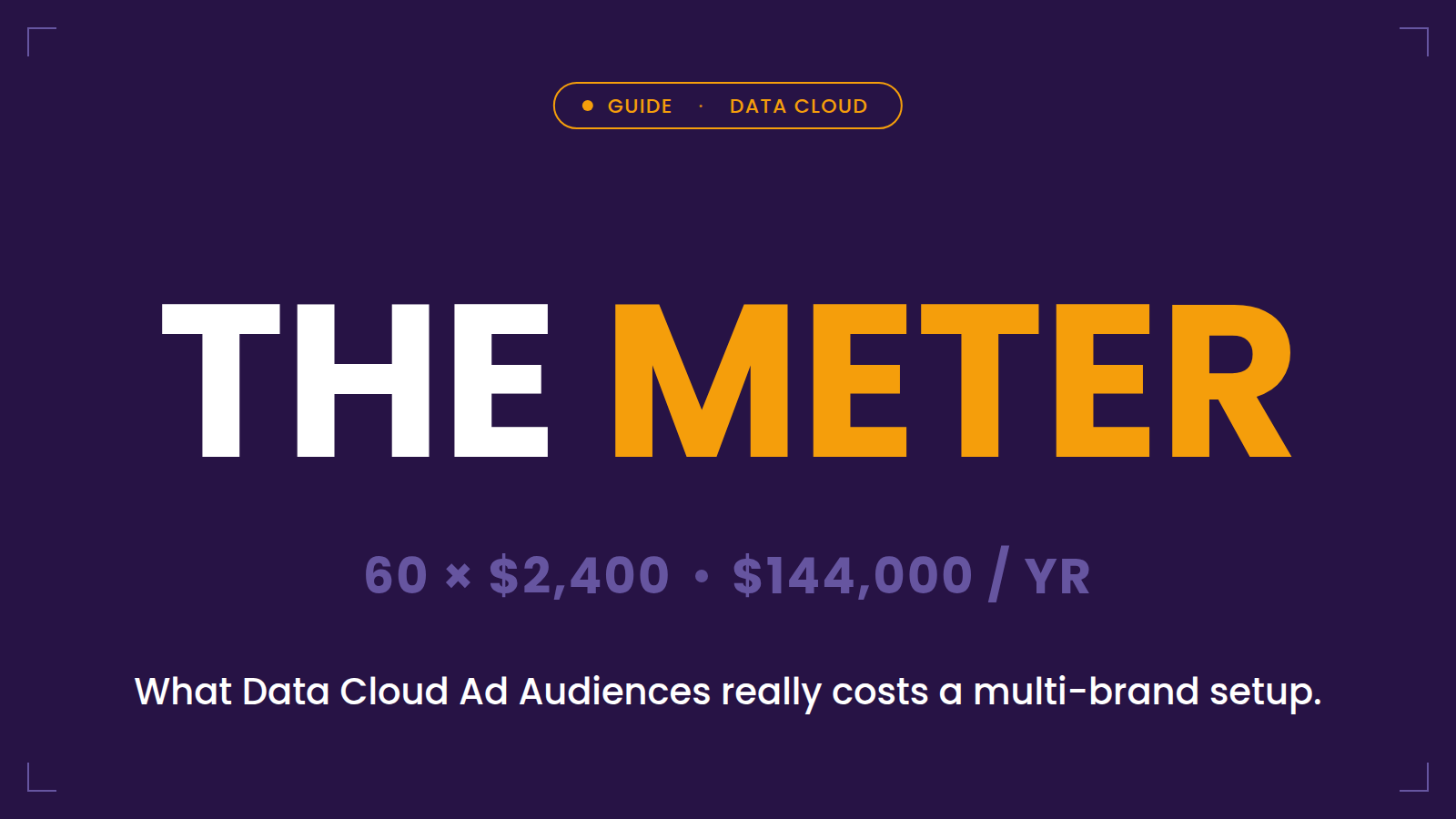
Under Ad Audiences, migrated one-for-one: 60 × $2,400 = $144,000 per year — before a single record is activated, and before everything the SKU sits on top of.
Even the modest version stings. A single brand with 25 audiences is $60,000 a year at list, for the activation layer alone, replacing something that used to be included.
What the meter sits on top of
Ad Audiences is an add-on to Data Cloud, not a standalone product. If you are licensing Data Cloud primarily for this migration, the full stack looks like this:
- The Data Cloud platform itself — the license that admits you to the building.
- Consumption credits — Data Cloud is metered by usage across its functions: data ingestion, mapping and unification, identity resolution, segmentation runs. Every scheduled audience refresh is segmentation activity; audiences that refresh daily consume credits daily. Sizing this before you have run it is notoriously hard, which is why it belongs in the estimate as a range, not a footnote.
- Data Spaces, one per brand — this is the multi-brand kicker. If your brands run on siloed data (and if they are in separate BUs, they do), each needs its own Data Space, which means the setup work — connections, mapping, identity resolution, consent — is not one project but one project per brand.
- Integration and people — connecting sources, rebuilding every Ad Studio segment as a Data Cloud segment, re-integrating ad platform connectors, upskilling a team onto a new platform, and the change management of moving audience ownership out of the tools the CRM team lives in. These are real costs even when they don't arrive on a Salesforce invoice.
None of this makes Data Cloud a bad platform. It makes it a platform — and pricing a platform migration as if it were a feature swap for Ad Studio is how migration budgets end up doubling after signature.
The second-order effect: the meter changes your audiences
Here is the part that worries us more than the invoice, because it touches performance rather than budget.
Put a $2,400 price tag on every audience, and teams respond the way teams always respond to meters: they consolidate. Six suppression lists become two broad ones. Brand-specific segments merge into group-level segments. The quick test audience for one campaign stops being created at all, because nobody opens a five-figure line item for a two-week test.
But granularity is precisely where CRM-driven advertising earns its keep. Across our customer base, CRM-built audiences deliver on average a +25% conversion uplift over CDP-built segments on the same campaigns — and the uplift comes from exactly the fine-grained lifecycle intelligence a per-audience meter taxes: the VIP exclusions, the churned-but-recoverable segment, the active-service-case suppression, the NPS-detractor hold-out. A pricing model that makes each additional distinction cost $2,400 a year is a pricing model that pushes your targeting toward coarseness. You pay once on the invoice and again in the campaigns.
And the destinations you'd still be missing
After all of the above, check the destination list. Data Cloud Ad Audiences activates to Meta, Google, Snapchat, Amazon Ads, and LinkedIn. X and Pinterest are not on it. Neither is TikTok. A multi-brand group running Ad Studio audiences on X or Pinterest today, or wanting the acquisition channel every B2C media plan now includes, ends the six-figure migration with a workaround problem — typically an external activation via file transfer and manual uploads, which is the CSV routine this entire category of software exists to eliminate.
How to compare honestly
If you are pricing the post-Ad-Studio options, put three numbers side by side for your audience count and refresh behavior:
- The full Data Cloud stack: platform license + consumption credits + $2,400 × number of audiences + one setup per Data Space.
- An alternative priced per active audience: no platform license or consumption credits underneath, and a per-audience price that drops as volume grows.
- The manual routine: the real cost in team-hours (and error risk) of the CSV export-and-upload workflow you would otherwise run.
Then check each option against your real destination list, not the overlap — X, Pinterest, and TikTok are absent from Ad Audiences entirely.
We are not neutral in that comparison, so we will state our side plainly: Cezium Ads works on your existing Data Extensions with no Data Cloud license, prices per active audience with no platform license or consumption credits underneath and a unit price that drops as volume grows, covers Meta, Google, TikTok, X, Snapchat, Pinterest, LINE, LinkedIn, and Amazon, and handles multi-BU setups with volume allocation per Business Unit instead of one platform build per brand. For organizations already committed to Data Cloud across the business, Ad Audiences can still be the coherent choice — we have said so before and it remains true. But coherence has a list price now, and it is $2,400 per audience, per year, per distinction your CRM team wants to keep making.
Do the multiplication before the QBR does it for you.
Frequently asked questions
How much does Data Cloud Ad Audiences cost?
The public list price is $2,400 per audience per year, on top of the Data Cloud platform it requires — its license, consumption credits (ingestion, unification, identity resolution, segmentation), and one Data Space per siloed brand. Negotiated prices vary; check the current Salesforce pricing page.
Is Data Cloud required for Ad Audiences?
Yes. Ad Audiences is an add-on SKU inside Data Cloud, not a standalone product. If you don't already run Data Cloud, the migration includes standing up the platform: source connections, identity resolution, consent, and segment rebuilds.
What does a multi-brand setup change?
Brands with siloed data each need their own Data Space, so the setup work multiplies per brand — and every audience each brand runs carries its own $2,400 annual line.
Which ad platforms does Data Cloud Ad Audiences support?
Meta, Google, Snapchat, Amazon Ads, and LinkedIn. X, Pinterest, and TikTok are not supported destinations.

Ready to transform your CRM audience activation?
Join marketers who've simplified their workflow with Cezium Ads