Advertising Studio End of Life: What Actually Happens on August 15, 2026
If you searched for "Advertising Studio end of life date" or "Advertising Studio August 2026," you found the right post. I'll keep this factual and specific, because most of what's circulating right now is either too vague or subtly optimistic in ways that will cost you later.
The Date and What It Means
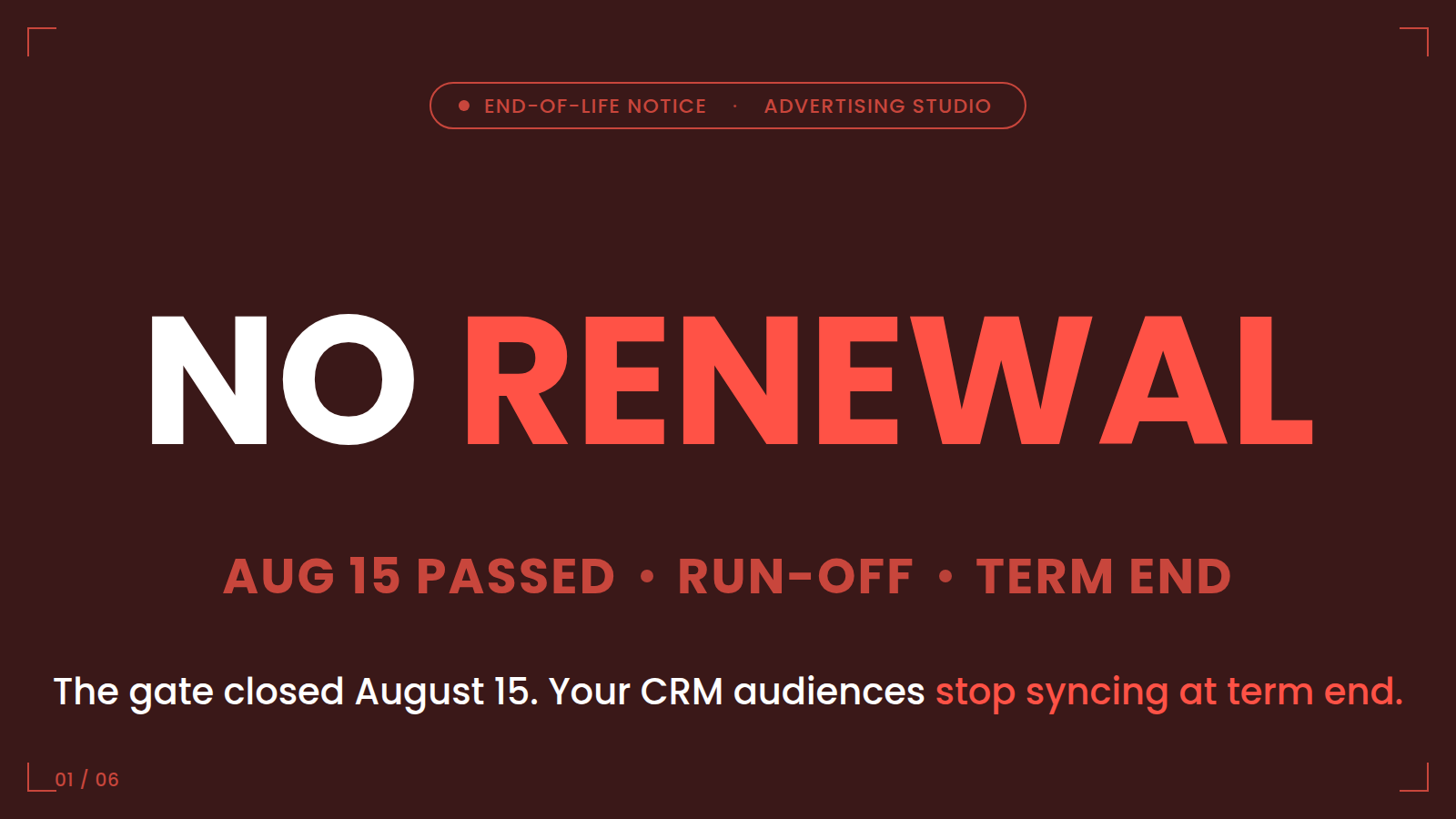
On August 15, 2026, Salesforce stops selling and renewing Advertising Studio (also known as Ad Studio). No new sales. No renewals. That is the hard cutover.
What it does not mean: the product disappears overnight for everyone. If you have an active Advertising Studio contract, it runs until its contractual expiration date. You keep access during that period. This is standard Salesforce end-of-sale practice — the product enters what the industry calls "run-off."
The distinction matters because the question most teams are asking is subtly wrong. They want to know when their access ends. The right question is: what happens to a run-off product between now and your expiration date, and what state will you be in when that date arrives?
What Degrades During Run-Off
A product in run-off is not the same as a product in active development. It is, at best, maintained. In practice, "maintained" means security patches and critical bug fixes if Salesforce deems them necessary — not new connectors, not API version upgrades, not responses to ad platform changes.
That matters more than most teams realize, because the paid social API landscape is not static.
Google Customer Match is a live example. Google is deprecating Customer Match in the Google Ads API and replacing it with the Data Manager API. The first hard cutover happened on April 1, 2026. Full sunset is expected within months. Late-lifecycle products like Advertising Studio are directly exposed to this kind of churn: if the ad platform changes an API and Advertising Studio doesn't adapt, the sync breaks. Salesforce has little incentive to maintain an API integration for a product it has already committed to sunsetting. I've written in detail about this specific migration and what it means for SFMC teams in the Google Customer Match migration analysis.
This is the deeper risk of the run-off period: it's not just that you're using an old product. It's that the external dependencies of that product — ad platform APIs, identity matching layers, OAuth flows — keep changing, and a sunset product absorbs those changes on a best-effort basis at most.
Beyond API risk, expect no investment in the feature roadmap. Platforms Advertising Studio never connected to — TikTok, Snapchat, Pinterest, LINE among others — will remain unavailable. Match rate improvements, audience segmentation features, and Journey Builder depth are frozen where they are today.
Three Realistic Options
When teams come to me with this question, they're usually deciding among three paths. Here's my honest read on each.
Option 1: Squeeze One Final Advertising Studio Term
If your contract expires before August 15, 2026, you could renew for one more term before the gate closes. This is legal and technically possible.
The argument for it: you buy time, defer a migration decision, and don't have to make a platform choice under pressure today.
The argument against it, and why I'd be cautious: you are paying for a product that Salesforce stopped investing in, against an API backdrop that is actively changing. Every month in run-off is a month of exposure to the Google Data Manager migration and whatever comes next. When that final term expires, you will negotiate your replacement with zero leverage — Advertising Studio is gone, Salesforce knows it, and you're migrating under time pressure rather than on your own schedule. Teams that delay migrations to the last possible moment consistently get worse outcomes, both technically and commercially.
There is one narrow case where a final renewal makes sense: you have a large re-platforming project already underway, you need the sync layer to keep running for a defined period, and you have a concrete end date. If that describes you, a final term can bridge you cleanly. If it doesn't, you're mostly delaying a forced migration and spending money for the privilege.
Option 2: Re-platform onto Data Cloud
Salesforce's proposed replacement path is Data Cloud, with Data Cloud Ad Audiences as the activation feature. This is a genuinely capable platform — if you understand what you're buying.
Data Cloud is a real-time customer data platform. It can unify identity across sources, build unified profiles, and activate audiences across paid channels through Ad Audiences. If you are already building on Data Cloud, or if your organization needs the full CDP capability — unified profile, AI-powered segmentation, cross-channel orchestration — then this is the right long-term architecture, and the paid social activation you lose from Advertising Studio becomes a relatively small feature inside a much larger platform.
Where it gets complicated is when Ad Studio teams look at Data Cloud purely as an activation replacement. First, it's a separate product and license, and if your only requirement is syncing audiences to Meta, Google, and TikTok, the cost is meaningfully higher than what you paid for Advertising Studio. Second, you have to ingest your data into Data Cloud before you can activate it — that's an integration project, not a configuration task. Third, standard terms typically mean commitments in the three-to-five-year range. Data Cloud is worth it for the right use case. As a like-for-like swap for Advertising Studio, it's expensive, slow to implement, and more platform than the job requires.
For a detailed cost comparison, I've covered this in the Data Cloud Ad Audiences cost comparison.
Option 3: A Focused AppExchange Replacement
The third option is replacing Advertising Studio with a native SFMC application that does the same job — audience sync from Data Extensions and Journey Builder to paid social platforms — without requiring a full CDP re-platform.
This category didn't have many credible options until recently. It does now. I'll address what to look for in an AppExchange replacement honestly, then mention what we've built.
What you need from this category: it should live inside your existing SFMC org (not a separate platform), connect to the same sources Ad Studio used (Data Extensions, Journey Builder), handle SHA-256 hashing of identifiers before anything leaves your environment, propagate opt-outs and deletions automatically, and connect to the platforms your media team actually uses — including ones Ad Studio didn't cover. The setup overhead should be days, not months.
Cezium Ads is what we built to fill this gap. It's a single AppExchange package, listed on the Salesforce AppExchange (passed the AppExchange security review), installable in one click in any SFMC org. Sources are the same as Ad Studio: Data Extensions and Journey Builder. Current destinations are Meta, Google, TikTok, X, Snapchat, Pinterest, LINE, LinkedIn, and Amazon — nine platforms, including TikTok, LINE, and Amazon, which Ad Studio never supported. Hashing happens inside the customer's own SFMC automation before any data is sent; we store no customer data. Pricing is per active audience, with starter packages from five audiences. Customers replacing Ad Studio typically land at least 40% below their previous Salesforce fees. The typical go-live is about a week.
I mention this last because it's the honest order: understand the landscape first, then evaluate specific tools. If the AppExchange path fits your situation, the alternatives post and the migration checklist go deeper.
A Decision Framework by Reader Situation
The right option depends heavily on where you are today.
Your only need is audience activation (you don't need a CDP). Data Cloud is more platform than you need. Look at focused AppExchange replacements. A final Ad Studio renewal is a delay tactic, not a solution, unless you have an active project with a concrete end date.
You're already building on Data Cloud or evaluating it for other reasons. The Ad Audiences activation feature is a natural addition to an existing investment. Don't over-engineer this decision. The question is whether your Data Cloud timeline leaves a gap you need to bridge — if so, an AppExchange tool can run in parallel during transition, and when you move to Data Cloud, you migrate your source, not your entire workflow.
Your contract expires before or near August 15, 2026. You're already at the renewal gate. A final term is possible but not available after August 15 — which means if your contract expires this fall or winter, you have a narrow window to decide whether to renew at all. Given the run-off risks, I'd evaluate alternatives now rather than defaulting to renewal.
Your contract expires 12-24 months out. You have the most leverage. You're not under pressure, Ad Studio is technically still running, and you can evaluate replacements properly, run a pilot, and migrate on your schedule. This is the best position to be in. Don't waste it by assuming the decision can wait until the last quarter.
FAQ
Can I still renew Advertising Studio after August 15, 2026?
No. August 15, 2026 is the last date for new sales and renewals. If your contract expires after that date, it runs to its natural end, but you cannot renew it.
What happens to my Advertising Studio access when my contract expires?
Access ends at contract expiration. There is no grace period or legacy access beyond the contractual term.
What replaces Advertising Studio in Salesforce's own product lineup?
Salesforce's official replacement path is Data Cloud with the Data Cloud Ad Audiences feature. This is a separate product license. If you're already investing in Data Cloud for other reasons, it's a natural fit. If activation is your only need, the cost and implementation scope are substantially higher than Advertising Studio.
Do I have to buy Data Cloud to replace Advertising Studio?
No. Data Cloud is Salesforce's path, but it's not the only option. AppExchange-native tools can replace the activation capability inside your existing SFMC org without a Data Cloud license or a separate infrastructure investment.
Will Advertising Studio keep working during run-off?
Technically, yes — until your contract expires. But run-off products receive no new feature development and minimal API maintenance. With Google already deprecating Customer Match in the Google Ads API (cutover April 1, 2026), the risk of an API break during your run-off period is real and increasing.
My contract doesn't expire until 2027. Do I need to do anything now?
The product still functions. But I'd recommend two things: track the Google Data Manager migration and verify your Google Ads sync is still functioning correctly, and start evaluating replacements with enough lead time to migrate without pressure. Teams that start late consistently have worse outcomes.
What's the difference between Advertising Studio and Data Cloud Ad Audiences technically?
Advertising Studio was a standalone sync layer: take a Data Extension or Journey Builder audience, hash the identifiers, push to an ad platform. Data Cloud Ad Audiences is an activation feature inside a full customer data platform — the data has to be in Data Cloud first, which means an ingestion and unification project before activation is possible. The output (hashed audience pushed to an ad platform) is similar. The input path and cost structure are very different.
For a side-by-side comparison of all replacement categories — including third-party CDP tools and custom API connectors — see Advertising Studio Alternatives: An Honest Comparison. For a step-by-step migration checklist, see The Advertising Studio Migration Checklist.

Ready to transform your CRM audience activation?
Join marketers who've simplified their workflow with Cezium Ads