Advertising Studio and Google's Data Manager API Migration
Update, October 1, 2026: Advertising Studio reached end of sale on August 15, 2026: no new contracts, no renewals, and syncs stop at each customer's term end. The questions to Salesforce below still matter, but as migration questions rather than renewal ones, and the five checks still apply to anyone running Google Customer Match audiences through Ad Studio until their term ends. For the run-off timeline, see what actually happens after August 15.
A behind-the-scenes look at what's changing in Google's Customer Match API, where it intersects with Advertising Studio's architecture, and the questions every SFMC customer should be putting to Salesforce before renewal.
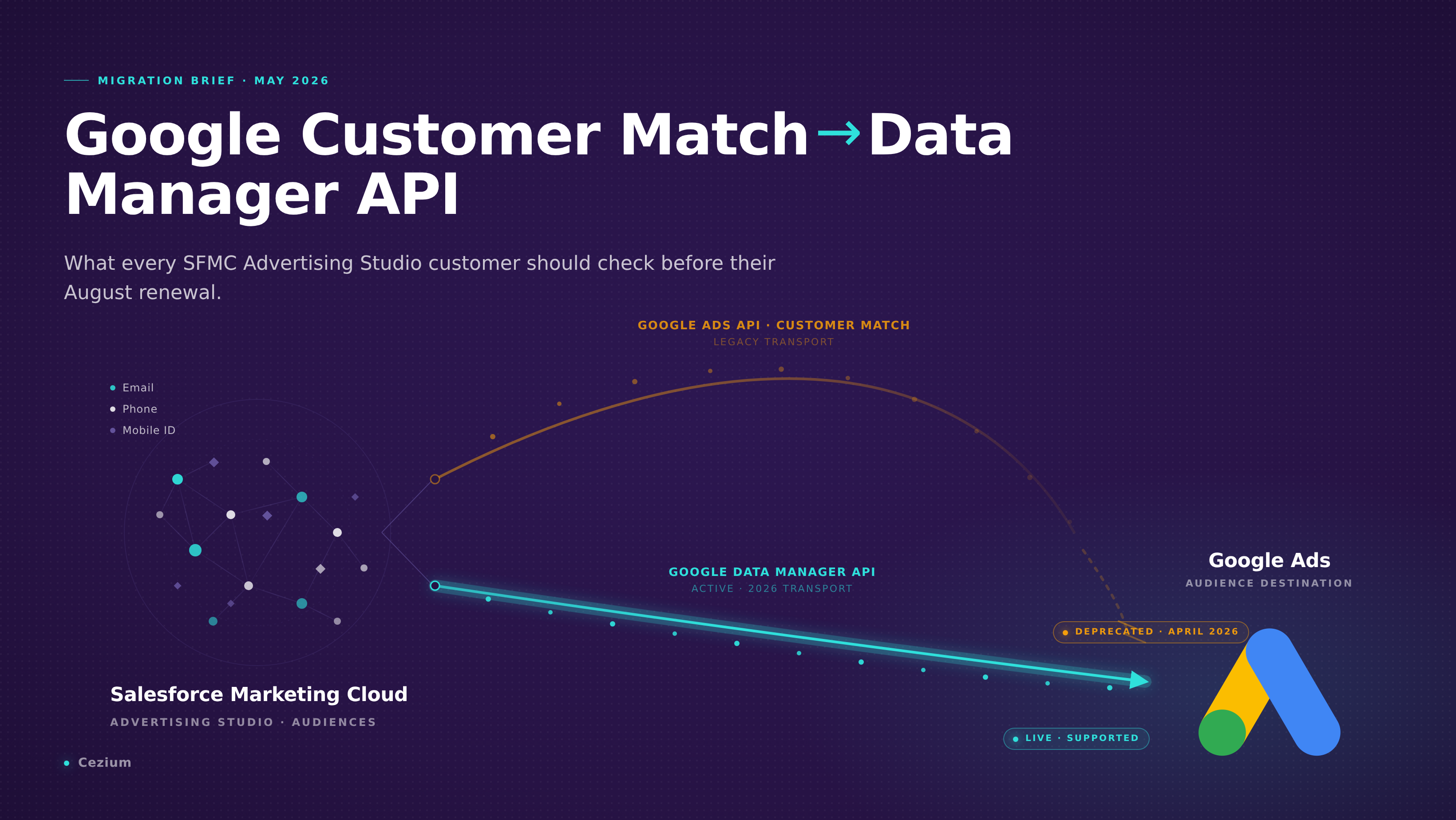
If you're running Customer Match audiences out of Salesforce Marketing Cloud Advertising Studio, there's a forced migration happening underneath you right now, and most SFMC customers I talk to haven't heard about it yet. Google is deprecating the Customer Match endpoints in the Google Ads API and moving everything to a separate, newer API called the Data Manager API. The first hard cutover already happened on April 1, 2026. The full sunset is expected within months.
Every vendor that pushes customer lists into Google Ads — Advertising Studio, Tealium, mParticle, Adobe, every CDP — has to do this migration. Some have. Some haven't. And the architectural shape of Advertising Studio makes this one particularly worth paying attention to, especially if you're heading into an August renewal.
Here's the timeline, the technical changes, what to check inside your Advertising Studio org this week, and the questions to put to your Salesforce account team before signing anything.
The timeline
- December 2025 — Google begins notifying developers that Customer Match access through the Google Ads API will be deprecated in favor of the Data Manager API.
- January 2026 — Related announcement: changes to IP address and session attribute handling in click conversions, pointing to the same architectural direction.
- March 4, 2026 — Official deprecation notice on the Google Ads Developers Blog.
- April 1, 2026 — Two things happened simultaneously: (1) new adopters can no longer integrate Customer Match through the Google Ads API, and (2) any developer who hadn't uploaded to a Customer Match list between October 2025 and March 2026 started receiving
CUSTOMER_NOT_ALLOWLISTED_FOR_THIS_FEATUREerrors. In practice, dormant connections silently break. - Q2–Q3 2026 (expected) — Full sunset of Customer Match in the Google Ads API. Google hasn't published a hard date, but the allowlist gating, the public migration guidance, and the strategic positioning of Data Manager all suggest this lands in the next few months.
If Advertising Studio hasn't migrated to the Data Manager API by the time the full sunset hits, your Customer Match syncs stop. Not slowly, not gracefully: stop.
What's actually changing under the hood
This is the section most coverage of the deprecation skips, so let me actually walk through it — because it matters for understanding why Advertising Studio specifically is exposed.
Old model (Google Ads API + Customer Match)
- Authentication uses a standard OAuth token tied to a user, with the Google Ads API scope.
- Uploads go through
OfflineUserDataJobServiceorUserDataService. - Identifiers (email, phone, address) are normalized and SHA-256 hashed before being sent.
- Consent is implicit, handled out of band.
- The vendor effectively acts on behalf of the authenticated user every time it talks to Google.
New model (Data Manager API)
- Authentication still uses OAuth, but the scope changes. The vendor needs
https://www.googleapis.com/auth/datamanagerin addition to existing Google Ads scopes. This means every customer has to re-authenticate Google Ads inside the vendor's UI to grant the new scope. There is no silent token upgrade — the user has to actively reconnect. - The vendor and the Google Ads account establish a formal product link, registering the vendor as an approved data partner at the Google Ads customer account level. This is a per-account configuration step done by the customer, not something the vendor can do behind the scenes.
- Uploads go through the Data Manager API's audience endpoints, which use list key types —
CONTACT_IDfor email/phone/address-based lists,USER_IDfor first-party user IDs,MOBILE_IDfor device IDs. Existing lists may or may not be compatible without remapping. - Consent and Customer Match terms of service must be passed explicitly in every ingestion call, as a formal field in the payload. Tealium's public migration documentation, for example, notes that their connector always sends
GRANTEDfor both Google consent fields in the request payload and relies on upstream consent logic to ensure only qualifying users are sent. - Normalization and hashing requirements are stricter and more formalized.
The practical implication: this is not a backend swap your vendor can do silently overnight. Every Advertising Studio customer using Google Ads Customer Match should, at minimum, see a "reconnect Google Ads" prompt and be walked through a product link setup once Salesforce ships the migration. If you haven't seen that prompt, the migration likely hasn't shipped yet.
Why Advertising Studio is specifically exposed
Two things make this migration harder for Advertising Studio than it is for a CDP or a dedicated audience platform.
First: the audience model is destination-coupled. In Advertising Studio, a "Customer Match audience" is essentially a Google Ads-shaped object. There's no concept of a single segment that can be syndicated to multiple destinations through pluggable adapters. If you want the same customer list to go to Google Ads and Facebook, you build two audiences. This works fine under the old API, where each destination has its own pipeline. Under Data Manager, it means the Google Ads-bound audiences are first-class objects that each have to migrate independently, with new list key types, new identifier mappings, and potentially new list IDs depending on how they're internally represented.
Second: Advertising Studio is in the late stage of its product lifecycle. Salesforce has been signaling for some time that the forward path for ad audience use cases is Data Cloud Ad Audiences, the newer product built on Data Cloud. Data Cloud Ad Audiences uses the Data Manager API natively — that side of the house is already aligned with where Google is going. The open question is how much engineering investment Advertising Studio gets to complete its own migration on a tight timeline, given that it's being positioned as the legacy product and many customers are being encouraged to move to Data Cloud Ad Audiences anyway.
I don't have a definitive answer on Advertising Studio's migration status. Salesforce hasn't published one publicly that I've seen, and my own checks haven't surfaced a "reconnect Google Ads" prompt or a known-issues advisory on Trust. But the absence of a visible migration signal isn't proof; it's a question. And it's a question worth asking your CSM directly.
What to check inside Advertising Studio this week
Five concrete things you can verify yourself, today:
- Have you been prompted to reconnect Google Ads inside Advertising Studio? If yes, the migration is in progress on your tenant. If no, either it hasn't shipped to your org yet, or it hasn't shipped at all. Either way, that's the signal to chase.
- Try to add a new Google Ads account to Advertising Studio. If new connections fail with a Customer Match allowlisting error, that's the April 1 cutoff at work — new adopters can no longer integrate through the legacy Google Ads API.
- Confirm your existing Customer Match list syncs are still completing successfully. Spot check recent sync history. Dormant lists that haven't been pushed to since the October–March window are at particular risk.
- Check the Salesforce Trust site, the Trailblazer Community, and any active Advertising Studio known-issues threads for advisories related to Customer Match, Google Ads, or the Data Manager API.
- Look at your OAuth scopes. If Advertising Studio's Google Ads connection in your org is still using only the legacy Google Ads API scope and hasn't added
datamanager, the new API isn't being used yet.
These five checks take an hour and give you a real read on where Advertising Studio is in the migration.
The August renewal angle
A lot of Advertising Studio contracts come up for renewal in August. If yours is one of them, the calculus has changed in the last few months.
You're being asked to commit to another year of a product that is in the middle of a forced API migration whose customer-facing impact hasn't yet been fully communicated, on a product line that Salesforce is positioning as the legacy alternative to Data Cloud Ad Audiences. That doesn't automatically mean you should leave — Advertising Studio still does useful things, and switching costs are real. But it does mean the questions you should be asking before renewal are sharper than they were a year ago.
Specifically, get the following in writing from Salesforce before signing:
- What is the Advertising Studio migration plan for the Google Ads Customer Match → Data Manager API transition? Be specific: which release, what month, what do my users have to do.
- Will my existing Customer Match audiences continue to flow without recreation, or will I be required to recreate them under the new key types? If recreation is needed, what happens to my list history, my sync state, my membership data?
- What is the contingency if Google's full sunset of Customer Match in the Google Ads API lands before Advertising Studio's migration is complete? Will customers experience downtime? What's the workaround?
- What's the relationship between Advertising Studio and Data Cloud Ad Audiences from a roadmap perspective? Is Advertising Studio receiving feature parity, or is it on maintenance only?
- If we move to Data Cloud Ad Audiences, what does that migration look like in terms of cost, setup, and what we carry over from Advertising Studio?
If the answers are vague — variations on "we're monitoring the situation" or "we'll communicate timelines through release notes" — that's information. Note it down and price it into your renewal decision.
The bigger pattern: audience matching as a feature vs. a product
Zoom out and the Google migration is one instance of a recurring pattern that everyone managing ad audiences inside a suite eventually runs into.
Every year, Google, Meta, TikTok, and LinkedIn ship breaking changes to their data ingestion APIs. Customer Match → Data Manager is the current one for Google. Meta's CAPI requirements have shifted several times in the last three years. TikTok's Events API evolves quarterly. Each change is a forced migration for whoever owns that integration in your stack.
When audience matching lives as a feature inside Marketing Cloud, it competes for engineering attention with email send infrastructure, journey builder, Einstein scoring, the mobile SDK, content blocks, and whatever the next big launch is. When a Google API deprecation lands in the middle of a quarter, it gets triaged against features that drive renewal optics. You don't have to guess which one wins.
When audience matching is the product, the math is different. The roadmap is the API roadmap. Deprecations are P0 the day they're announced. Migration windows are budgeted for, not crammed into the last six weeks before a vendor's sunset deadline. This isn't an argument against integrated suites — there are real reasons SFMC customers value the integration with Sales Cloud and Service Cloud. But it is an argument for being clear-eyed about where Customer Match falls on the suite's internal priority list, especially during a forced migration like this one.
The Google Customer Match migration is the test. Whoever handles this one cleanly is the one you can trust with the next one — and there will be a next one.
What to do this week
For Advertising Studio customers, three concrete actions:
- Run the five-check diagnostic above to figure out where Advertising Studio is on your tenant.
- Open a ticket with Salesforce Support asking the five renewal questions, even if your renewal isn't until later in the year. Get the answers documented.
- If you're in the August renewal window, factor those answers into your decision before signing. A short-term renewal (quarterly, six months) is a reasonable middle path if Salesforce's migration timeline isn't yet clear.
If you're in the broader SFMC community and you've seen — or notably haven't seen — a reconnect prompt, a migration advisory, or a known-issue on Customer Match, get in touch. I'm tracking this closely and will keep updating this post as more information comes out from Salesforce, from Google, and from customers on the ground.
Sources
- Changes to Customer Match Support in the Google Ads API — Google Ads Developers Blog, March 4, 2026
- Data Manager API for Customer Match imports (Google Ads) — Google Developers documentation

Ready to transform your CRM audience activation?
Join marketers who've simplified their workflow with Cezium Ads